Most audience-intelligence tools start the same way: license a clickstream panel, watch millions of opted-in users move around the web, and report back what "your audience" does. SparkToro does this well. It's the right way to build that product, and we're not going to pretend otherwise.
We didn't do that. Not because we found a clever shortcut, but because a panel is a multi-million-dollar moat we don't have and won't fake. So we built Audience Intelligence on the data we do own honestly — search behavior, SERPs, community signals, marketplace signals — and we made a rule we haven't broken: never dress an inference up as a measurement.
This post is the honest version of how it works, where it's genuinely good, and where it can't match a panel yet. If you've read our digital marketers in India breakdown, you already know we'd rather tell you the gap than hide it.
The fork in the road: panel vs. search
There are really only a few ways to know anything about an audience at scale. Panels (SparkToro, via a licensed clickstream of millions of opted-in users). Social listening (enterprise-grade, not our fight). Surveys (GWI, YouGov — not our data). And search-intent signals — what people actually type — which is our turf.
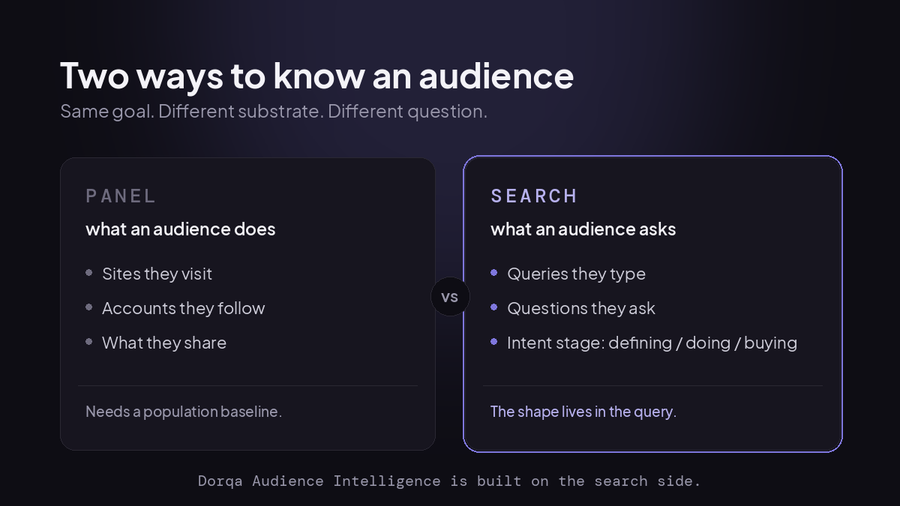
Each answers a different question. A panel answers "what does this audience do?" — what they visit, follow, share. That's its superpower, and it produces things our stack structurally cannot. In SparkToro's own vibe-coding study, they can tell you that audience over-indexes heavily on specific AI coding tools, and score a tool's affinity against the average internet user. Those numbers require a population baseline — a denominator of "the average internet user" — that only a panel gives you. We don't have it. We're not going to invent it.
What we answer instead is "what is this audience searching, and at what stage of intent?" That's a narrower claim. It's also a true one — and it's a claim a panel can't make even with all its data, because intent stage lives in the shape of the query, not in clickstream movement.
So the honest framing isn't "Dorqa is a better SparkToro." It's: different substrate, different question, and we only make the claims our substrate can back.
What we actually built
Audience Intelligence takes an audience as input — "freelance designers," "SaaS founders," "digital marketers" — not a topic and not a keyword. That's a deliberate constraint, not a UX nicety. When the thing you type is the way an audience names itself, "this is what this audience searches" is a true statement. Type a topic and it isn't — so topics get routed to Trend Intelligence, and single keywords to Keyword Research.
From that one input, the module assembles an honest join of sources we already operate:
Search Intelligence — what the audience actually types, from Google autocomplete, People-Also-Ask, and related queries, grouped by what they're trying to figure out. Not a volume-ranked list of keywords that happen to contain the seed phrase — that's keyword research wearing an audience costume, and we keep it collapsed and labeled as exactly that.
Active Conversations — real engagement signals: Reddit threads, YouTube videos with view counts, Amazon books people actually bought and reviewed.
Where They Discuss — the live communities, across Reddit, Quora, Hacker News and more.
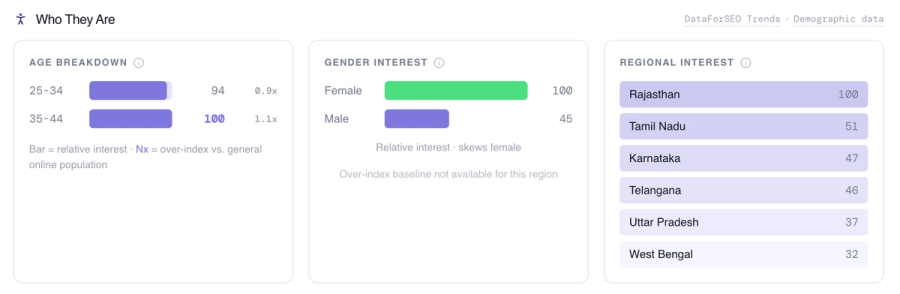
Who They Are — demographic skew from DataForSEO Trends, and the section where we're most careful about what the numbers actually mean.
Trend Signal — whether the audience's topics are rising in our own Trend Engine, with an honest empty state when they're not.
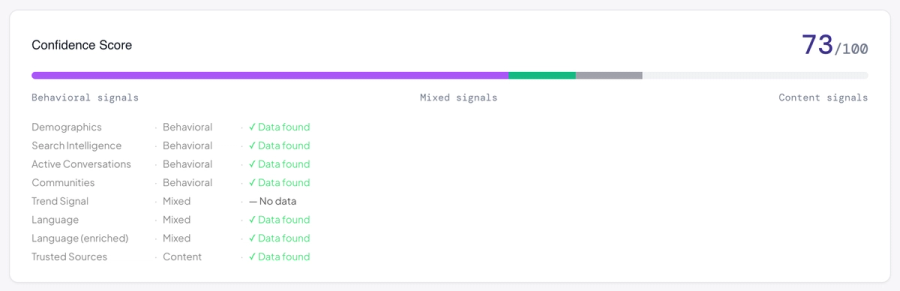
Every section carries a Confidence Score that weights behavioral signals (65 points) above mixed signals (25) above pure content signals (10), and shows you, line by line, which sections returned real data and which came up empty. When a section has nothing, it says so. We spent a long time making "no data" a first-class, visible state instead of a blank we quietly hide.
One concrete example of the discipline: the "Who They Are" charts show relative interest, scaled so the strongest band reads 100. They are not a distribution — the bars don't add to 100, and an early version that implied they did (a "gender split" reading 177%) was exactly the kind of dishonest-by-accident chart we now refuse to ship. The real signal is the over/under-index multiplier, and the labels say so.
The one thing a panel can't do
Here's the part we're proudest of, and it falls straight out of owning the search layer: intent-stage splitting.
The module classifies every query an audience makes by intent and shows you the split — informational, commercial, transactional. Read another way, that's defining the thing, doing the thing, and buying the thing — and the chart shows where an audience's search energy actually sits.
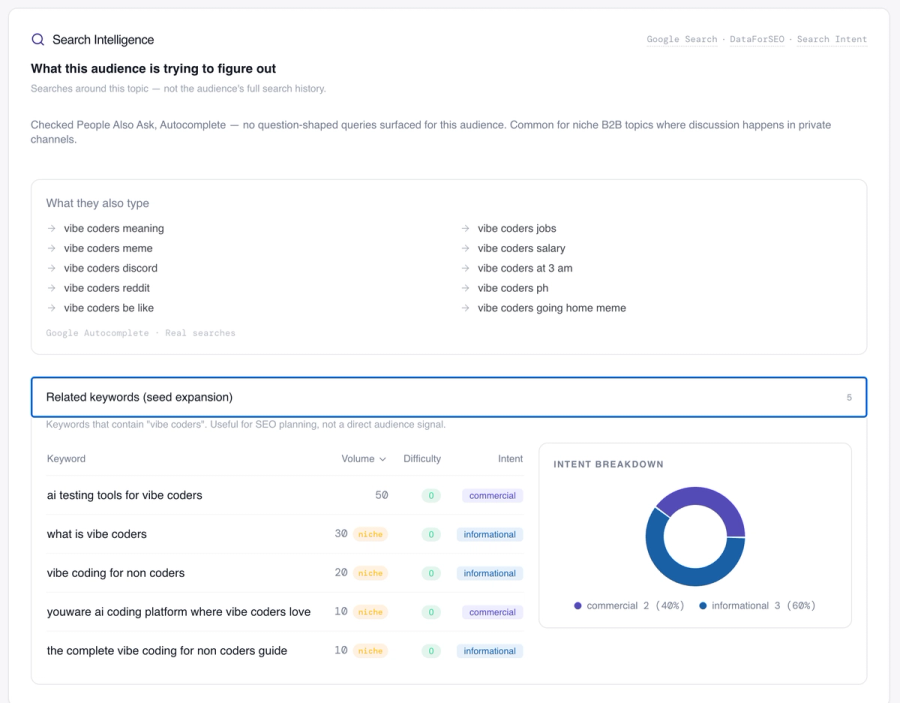
When we ran this on digital marketers in India, the result was a content strategy in one chart: almost half the volume was people still asking what the job even is — definitional queries, not tactical ones, not commercial ones. That's a finding you can act on tomorrow: it tells you the audience is earlier than your content assumes. A panel can tell you where that audience hangs out. It cannot tell you that half of them are still defining the category — because that lives in the words of the query, and a panel watches movement, not phrasing.
Our edge isn't a new data source — it's an honest join of ones we already had, pointed at a question a panel can't answer.
What it still can't do (the part most tools leave out)
If we stopped here it'd read like a launch post. It isn't. Here's what Audience Intelligence honestly cannot do today:
No affinity / over-index number. This is the big one, and it's the exact thing that makes a SparkToro report sing. To say "this audience over-indexes on X by 4x," you need a general-population baseline to divide against. We don't have one yet, so we don't print the number. "Top communities for this audience" is commodity; "r/X, 100 affinity" is the game — and we're not there. It's the next thing we're building, and we'll build it on a defensible search-volume baseline, framed as affinity, with the method stated openly — never as a headcount.
We can't tell you what your audience asks AI. Nobody can, honestly — there is no public dump of real AI prompts, and the "AI prompt" data floating around the industry is model-generated from keywords, not captured usage. What we can tell you, because it's already our AI Visibility module, is whether you show up in AI answers for this audience's real queries. We measure the visibility, not the demand. Any "AI demand" figure you see from anyone is a proxy, and we'll label ours as one if we ever show it.
Demographics are interest, not population. Regional and gender data is relative search interest, strongest for India and the US, thin elsewhere. It tells you where interest concentrates per head — not where most of the audience lives.
It needs a nameable audience. "Digital marketers" works. "Busy parents" drifts, because the queries scatter and the core claim breaks. The tool is strong on self-identifying audiences and honest when your input is too broad — it'll point you to the right module rather than guess.
What's next
In rough order: the affinity baseline (the over-index engine), AI platforms as a first-class discovery channel, native platform APIs to replace SERP-pattern scraping, broader platform coverage, and a language-gap layer — how an audience phrases something to Google versus how they ask peers on Reddit. We have both halves of that last one already; the diff is the artifact, and it ships after the affinity work.
We built this the slow, honest way because the alternative — proxies dressed as measurement — is the thing we spent months killing in our own product. If "an audience tool that tells you what it doesn't know" sounds useful, try Audience Intelligence on an audience you actually serve and see how far the honest version gets you.
Audience Intelligence is part of Dorqa. Be first. Not just found.
