Most audience research on digital marketers is built for an American readership. The reports profile US marketers, rank US platforms, and quietly assume the rest of the world looks the same with a different time zone. India is one of the largest English-speaking markets online, and it does not look the same.
So we ran a Dorqa audience report on "digital marketers" with the location set to India. Dorqa builds its profile from search behavior and public discussion rather than a fixed opt-in panel, which means it reads a market like India directly instead of inferring it from a sample collected somewhere else.
Four things stood out.
Finding 1: They are not where you think
The interest does not cluster where the stereotype would predict. The autocomplete data backs this up. People type "digital marketers in kerala," "digital marketers in calicut," and "digital marketers in palakkad" often enough that these surface as real search completions. Calicut and Palakkad are not where most marketing budgets picture their audience.
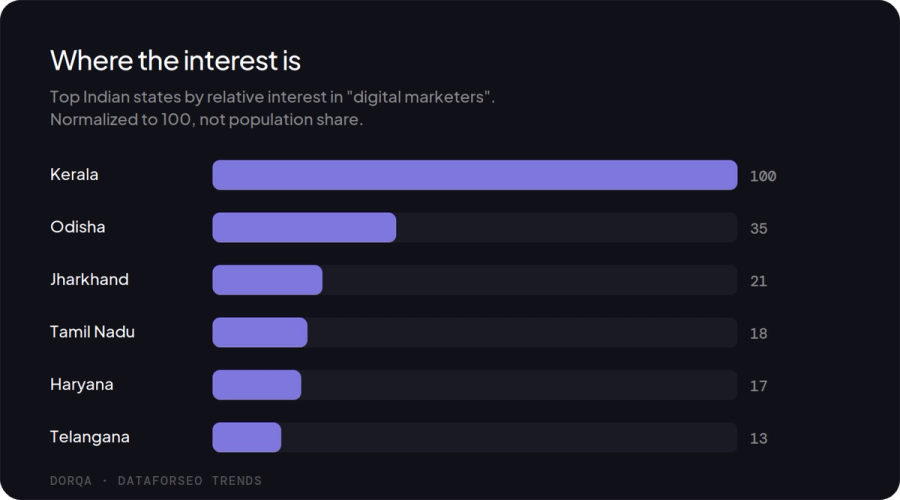
On a relative basis, Kerala leads at 100, with Odisha at 35, Jharkhand at 21, Tamil Nadu at 18, Haryana at 17, and Telangana at 13. These are relative interest scores normalized to 100, not population share, so read them as where the topic runs hot, not headcount.
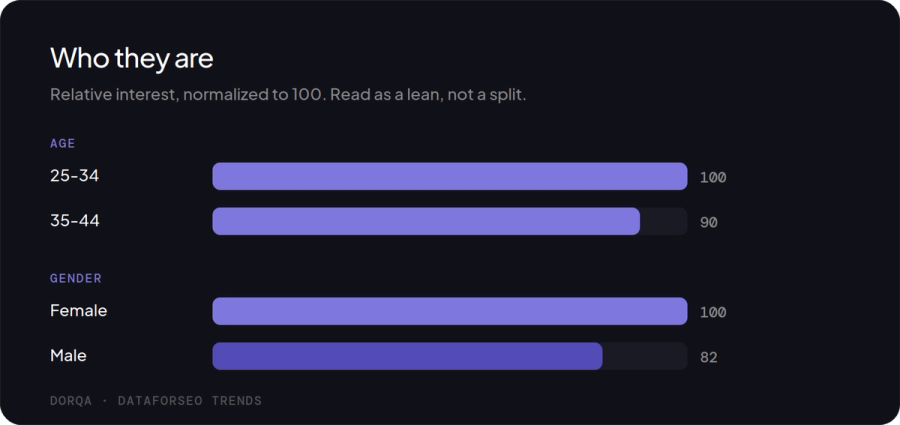
A note on how to read this, updated since publish. Dorqa now reports over-index, not just presence, measured against India's general online population. Running this audience through that lens is clarifying: the 25 to 44 concentration is presence, not over-index. This age band indexes at about 1.0x, meaning digital marketers skew the same way the general Indian online population does rather than standing out from it. So read the age and regional figures as where this topic shows up, not as proof it over-indexes there versus everyone else. The one place we still hold back is gender: we do not publish a gender over-index baseline for India, because the country's online gender split is too skewed to be a fair denominator, so treat the female lean as relative interest, not a measured over-index.
The audience also skews young and slightly female. Interest peaks in the 25 to 34 band and stays strong through 35 to 44. On gender it reads female 100, male 82. Read that as a lean, not a split.
For anyone building a course, a community, or an agency hiring funnel, that is the first assumption worth dropping. The interest is not only in the metros.
Finding 2: They are searching for the job, not the tactics
Here is the second surprise. When you look at what this audience actually searches and asks, very little of it is about tactics.
Strip the bare category term, which is just the label people type when they want to hire or define the role, and four real queries remain. "What are digital marketers" pulls 40,500 and is purely informational. "Digital marketers jobs" pulls 22,200. "Seo for digital marketers" pulls 18,100. "Digital marketers meaning" pulls 12,100. Two of the four are someone asking what the job even is. With the category term removed, the set splits evenly, half informational and half commercial, and the informational half is all definition-and-entry queries.
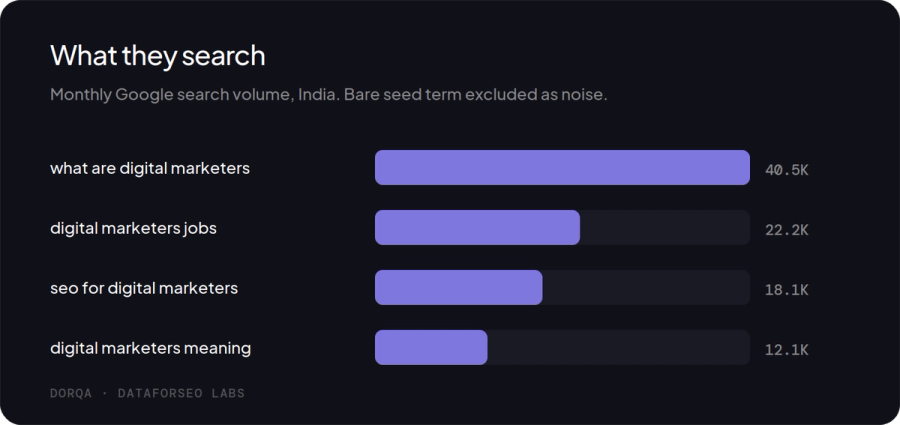
That is not the search pattern of established practitioners optimizing their craft. It is the pattern of people deciding whether this is a career worth entering.
One caveat we will not skip: these are Google volumes. The informational share, the "what are digital marketers" style queries, is exactly the intent that is migrating into AI chat. So that informational half is likely understated and shrinking as the questions move off search. Read the Google picture as the visible floor of demand, not the whole of it.
Finding 3: The conversation is "what is this job," not "how do I do it better"
This is the part you cannot get from a keyword tool, and it is where the picture sharpens.
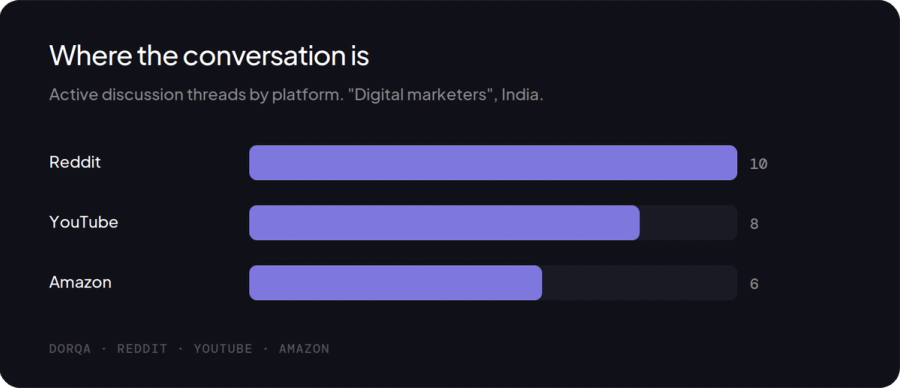
Dorqa pulled live discussion from Reddit, YouTube, and Amazon, then mapped where this audience gathers across Reddit, Quora, Hacker News, Product Hunt, LinkedIn, and Indie Hackers. The striking thing is not where they are. It is what they are saying.
On AI platforms, an honest gap. If you are reading where this audience shows up in 2026, the obvious question is AI assistants. For a "what is digital marketing" audience, a real share of that learning has almost certainly moved into ChatGPT, Perplexity, and the like. We are not showing AI platforms in this read, and we are not going to estimate them, because we do not yet have a measured signal for how this audience uses AI tools. Dorqa already tracks brand mentions across AI assistants in its AI Visibility module, so the rails exist; turning that into an audience-channel signal is on the build list, not in this report. Read the absence as a gap we are naming, not a channel that does not matter.
On Reddit, the highest-intensity threads are not about tactics. They are about the job itself. "What do you usually do as a Digital marketer?" "What exactly does digital marketing mean?" "What does it take to be a great digital marketer?" These are people standing at the edge of the field looking in, not practitioners comparing attribution models.
YouTube says the same thing louder. The videos with real pull are beginner on-ramps, not advanced breakdowns. "How To Start Digital Marketing for Beginners" carries 441,000 views. The Simplilearn explainer sits at 6.4 million. "How I Would Learn Digital Marketing If I Could Start Over" pulls a million. The audience is consuming entry content at a scale that dwarfs anything technical.
Amazon rounds it out. The books that surface are "For Dummies," "Digital Marketing Analytics," and integrated-strategy texts. Foundational, not specialist.
Put the three together and the audience reads as early-stage and self-teaching. On LinkedIn, the high-intent post is literally titled "My Story, How I started my career as a Digital Marketer," describing joining freelancing platforms and landing a first project for fifteen dollars. On Quora, "Who are the best digital marketers in India" sits next to "What should I learn first." On Hacker News, "How do you learn digital marketing." Every platform tells the same story from a different angle.
If you sell to this audience, that changes the offer. They are not looking for a better tool to do the work. They are looking for a way into the work.
Finding 4: They speak in fundamentals and trust the educators, not the vendors
The last layer is language and authority, and it confirms the rest.
The phrases this audience actually uses are foundational, not advanced: digital marketing, target audience, paid advertising, social media ads, content marketing, eCommerce stores, growth marketing. The questions they ask are not "which platform should I migrate to," they are "what are the struggles of digital marketers," "how do you find small businesses who need digital," and "what is the one recurring problem." This is the vocabulary of people building a foundation, not optimizing one.
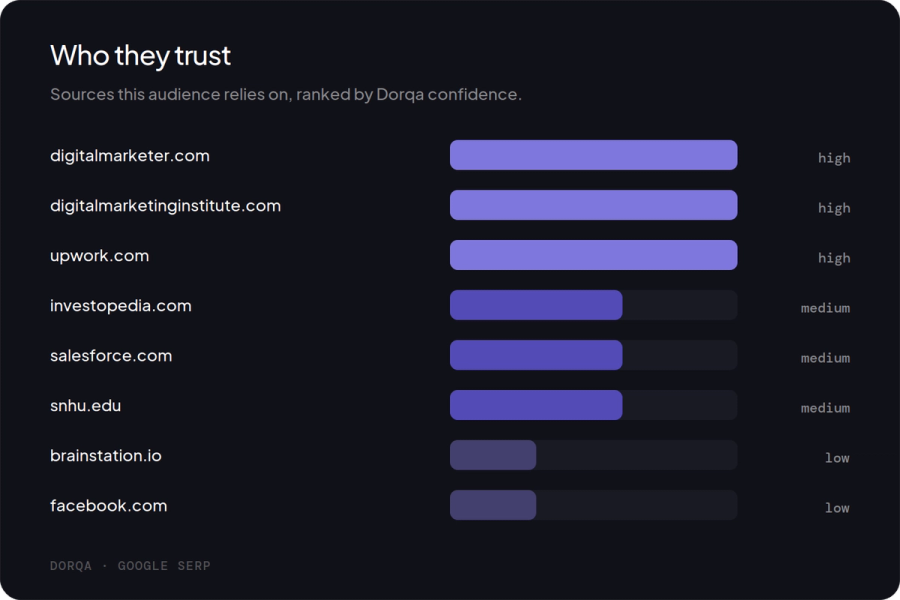
The sources they trust make the same point. The high-confidence sites are digitalmarketer.com, digitalmarketinginstitute.com, and upwork.com. Read that trio together: two educators and a freelance marketplace. Learn the craft, then sell it. Investopedia, Salesforce, and snhu.edu follow at medium confidence. On the audio side, The Digital Marketing Podcast and the Neil Patel and Eric Siu show carry the trust.
One honest note: no marketing newsletters surfaced in this read, and we will not oversell that. It may mean the email-first creators have not captured this audience yet, or it may simply mean newsletters sit outside the sources Dorqa currently scans. Until we cover that channel directly, treat the absence as a blind spot to verify, not a confirmed open lane.
One last limit, because the tool reports it and so should we. Dorqa scored this read at 73 out of 100 confidence. The demographic, search, conversation, and language signals all came back with data, so the behavioral picture is solid. The one gap is the Trend Signal, which returned no data because this topic is not yet tracked in the velocity engine, so we are not claiming momentum we cannot see. We would rather mark what is provisional than dress it up.
What this means
One audience, one country, and the standard playbook already bends. The audience for "digital marketers" in India is younger than the profile assumes, shows up well beyond the metros, and is still deciding whether to enter the field rather than optimizing inside it. It trusts educators and marketplaces over vendors, and speaks in fundamentals, not tactics.
What you do with that depends on your seat. If you are building a course, the on-ramp content this audience already consumes is your syllabus, not advanced tactics. If you are building a community, the entry-level questions on Reddit and Quora are your first threads. If you are running an agency hiring funnel, look past the metros, because the interest concentrates in places like Kerala and the tier-two cities. The report does not just describe the audience. It tells you where to stand.
None of that came from a panel of US marketers with the timezone changed. It came from reading the market directly: what people search, where they gather, how they talk, and who they believe. That is the difference between inferring an audience and seeing one.
Be first. Not just found.
